A Chemistry Professor at the University of Nottingham in U.K. received a super cool (in the most geeky way) present for his birthday -- the Periodic Table etched on a strand of his own hair. This was done for Professor Martyn Poliakoff by the nanotechnlogists of the university. This is what it looks like:
The 118 elements of the Periodic were carved using a beam of gallium ions. This technique is usually utilised to do repair works on extremely small components of semi-conductors. So, how small is this Periodic Table? Each letter carved has a height of four microns -- that is 4 × 10⁻⁶ m. The entire Periodic Table is 88 microns wide, and 46 microns tall. If this were to be done on a Post-it note, almost one million of them can be fitted on a single piece of the note paper.
A video was made to show how the process was carried out. Check it out here:
Saturday, January 15, 2011
Monday, January 10, 2011
Counterfeit eggs in China
If you have read the Straits Times a few days ago, you would have seen a report on how some people in China are using chemicals to make counterfeit eggs. These fake eggs look exactly like the real ones and the total cost of making each of them is only one-tenth the price of a real egg. These are the steps to make a fake egg:
The process used to create the spherical yolk and egg white is actually a technique commonly used in molecular gastronomy to make little spheres which are liquid in the centre, and have a thin jelly layer outside. I have tried this item of molecular gastronomy, and saw the chefs making the spheres with mango juice. What the chefs do is to dissolve some sodium alginate (or what is known as sodium alga acid in the flowchart given above) in fruit juice, then drip drops of the mixture into a solution of calcium ions. The calcium ions will react with the alginate to form a thin membrane, enveloping the fruit juice in it and forming a small ball. This is the exact reaction the counterfeiter in the video carried out when he was swirling the orange sphere around in the colourless liquid in the mould. While chemicals such as sodium alginate and calcium chloride are not harmful to the human body, I can't say the same about some of the rest of the chemicals the counterfeiters use to make the eggs.
And a video to show the actual process:
The process used to create the spherical yolk and egg white is actually a technique commonly used in molecular gastronomy to make little spheres which are liquid in the centre, and have a thin jelly layer outside. I have tried this item of molecular gastronomy, and saw the chefs making the spheres with mango juice. What the chefs do is to dissolve some sodium alginate (or what is known as sodium alga acid in the flowchart given above) in fruit juice, then drip drops of the mixture into a solution of calcium ions. The calcium ions will react with the alginate to form a thin membrane, enveloping the fruit juice in it and forming a small ball. This is the exact reaction the counterfeiter in the video carried out when he was swirling the orange sphere around in the colourless liquid in the mould. While chemicals such as sodium alginate and calcium chloride are not harmful to the human body, I can't say the same about some of the rest of the chemicals the counterfeiters use to make the eggs.
Sunday, August 1, 2010
Fritz Haber -- great or evil?
These two weeks, we have been studying about systems known as chemical equilibria. One of the most important chemical equilibrium reactions in the world is the Haber Process, which is the reaction between nitrogen and hydrogen gas, to form ammonia: N2 + H2 --> NH3.
This is an important process as it produces ammonia, which is an important starting material for the production of fertilizers. With the Haber Process, the world is no longer reliant on natural deposits for nitrogen-containing compounds. Nitrogen, which is the main component of air, can now be harnessed to produce the nitrates and nitrites required to manufacture fertilizers. At the present, 100 million tons of nitrogen fertilizer is being produced yearly through this process and this amount of fertilizer is responsible for feeding one third of the world's population.
So who was the chemist behind this amazing innovation that changed how the world feeds? He is a German chemist, named Fritz Haber. When he was at the University of Karlsruhe from 1894 to 1911, he worked with another chemist, Carl Borsch to develop the Haber Process. In 1918, both scientists won the Nobel Prize in Chemistry for their innovation.
While the Haber Process aided humanity by enabling mankind to produce fertilizers easily, leading to an increase in food production, the ammonia produced is also highly sought after for the production of explosives. With this technology, Germany was able to easily produce the ammunition required for the first World War, which extended their path to surrender, and prolonged the suffering of the parties involved in the war.
On top of contributing to WWI by providing his country with the means to produce explosives, Fritz Haber also played a major role in developing chemical warfare for the war. He developed chlorine gas to be used to poison the opponent forces and was even present at the war zone to release the gases on the soldiers. When exposed to chlorine gas at a high concentration, the gas will react with the water in one's lungs to form hydrochloric acid. This will cause the sacs in the lungs to break down, causing the lungs to be flooded. In other words, one is drowned internally by the moisture present in one's lungs.
Fritz Haber was proud of his contributions as a chemist to the war, but his wife, who was also a chemist, opposed his work on poison gas. She committed suicide on the day Haber left to oversee the release of poison gas on the Russian to demonstrate her stand.
Despite Haber's contributions to Germany during the first World War, he had to leave Germany in 1933 as he was Jewish. He moved to England and finally passed away due to heart failure in the Middle East.
The Haber Process helped to save the world from wide-spread hunger, but at the same time, provided man with the avenue to produce explosives easily. Such is an example of how Science can sometimes be a double-edged sword.
This is an important process as it produces ammonia, which is an important starting material for the production of fertilizers. With the Haber Process, the world is no longer reliant on natural deposits for nitrogen-containing compounds. Nitrogen, which is the main component of air, can now be harnessed to produce the nitrates and nitrites required to manufacture fertilizers. At the present, 100 million tons of nitrogen fertilizer is being produced yearly through this process and this amount of fertilizer is responsible for feeding one third of the world's population.
So who was the chemist behind this amazing innovation that changed how the world feeds? He is a German chemist, named Fritz Haber. When he was at the University of Karlsruhe from 1894 to 1911, he worked with another chemist, Carl Borsch to develop the Haber Process. In 1918, both scientists won the Nobel Prize in Chemistry for their innovation.
While the Haber Process aided humanity by enabling mankind to produce fertilizers easily, leading to an increase in food production, the ammonia produced is also highly sought after for the production of explosives. With this technology, Germany was able to easily produce the ammunition required for the first World War, which extended their path to surrender, and prolonged the suffering of the parties involved in the war.
On top of contributing to WWI by providing his country with the means to produce explosives, Fritz Haber also played a major role in developing chemical warfare for the war. He developed chlorine gas to be used to poison the opponent forces and was even present at the war zone to release the gases on the soldiers. When exposed to chlorine gas at a high concentration, the gas will react with the water in one's lungs to form hydrochloric acid. This will cause the sacs in the lungs to break down, causing the lungs to be flooded. In other words, one is drowned internally by the moisture present in one's lungs.
Fritz Haber was proud of his contributions as a chemist to the war, but his wife, who was also a chemist, opposed his work on poison gas. She committed suicide on the day Haber left to oversee the release of poison gas on the Russian to demonstrate her stand.
Despite Haber's contributions to Germany during the first World War, he had to leave Germany in 1933 as he was Jewish. He moved to England and finally passed away due to heart failure in the Middle East.
The Haber Process helped to save the world from wide-spread hunger, but at the same time, provided man with the avenue to produce explosives easily. Such is an example of how Science can sometimes be a double-edged sword.
Thursday, July 29, 2010
The Science in Inception
I formally declare: Inception is now my new favourite movie. I love the whole concept of intruding dreams, bending reality and manipulating situations. Here is an article from New Scientist that discusses some of the neuroscientific concepts on which the movie is based.
If you haven't watched the movie, go watch it over the weekend if you have finished studying for your Lecture Test!
Sunday, July 25, 2010
Buckyballs in space!
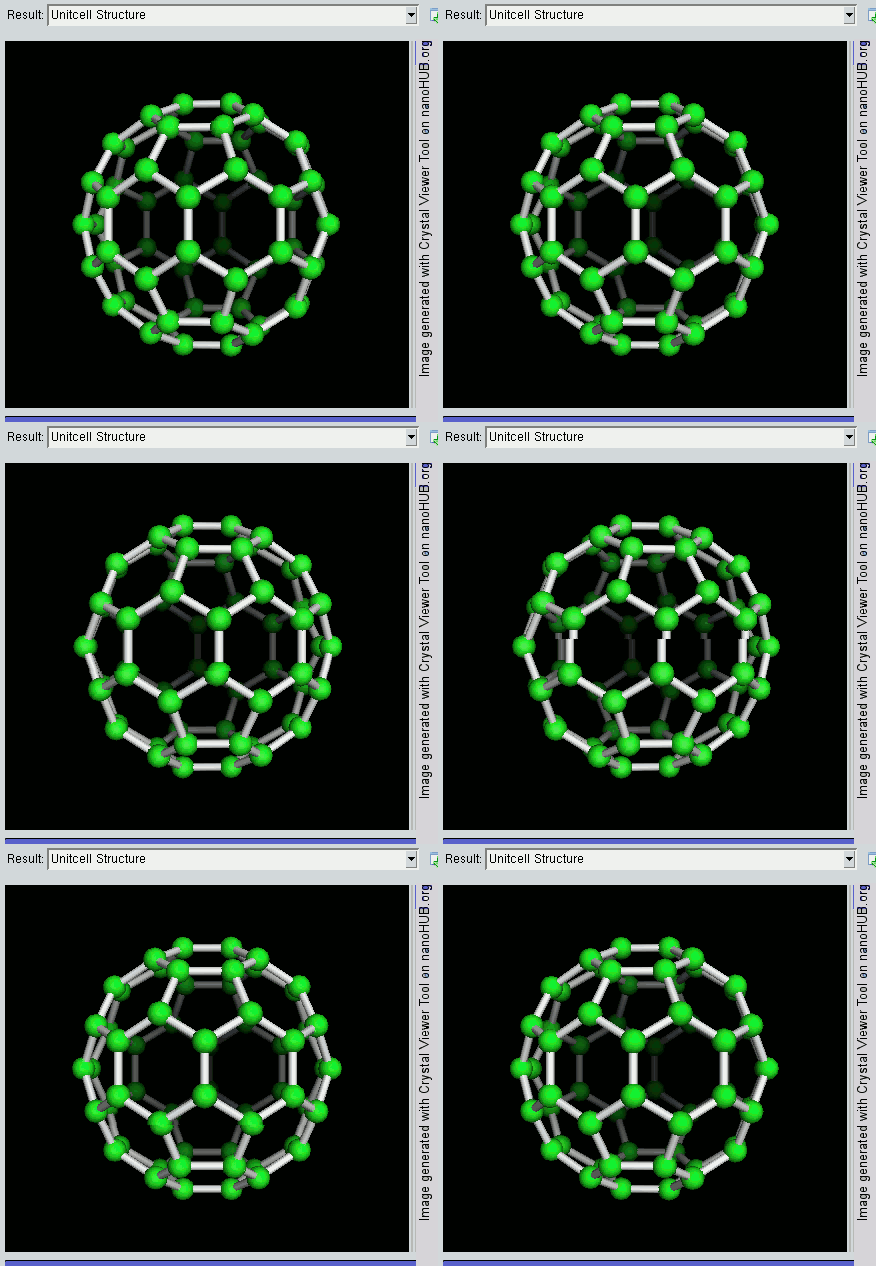
So far, we have become very good friends with two allotropes of carbon -- diamond and graphite. Allotropes are essentially elements in which the atoms have been arranged differently. As a recap, diamond and graphite are both made up of carbon atoms, but diamond adopts a tetrahedral lattice, but graphite has a layered structure. Let's meet another allotrope of carbon -- the buckyball.
The buckyball is made up of 60 carbon atoms, linked together in such a way to form a molecule that looks like a soccer ball. C60 was first discovered by a group of scientists from the Rice University in 1985. They named it buckminsterfullerene, after Richard Buckminster Fuller, an American architect who was one of the first to design buildings that resembled the buckyball (geodesic domes). The scientists, Sir Harry Kroto, Bob Curl and Rick Smalley won the Nobel Prize in Chemistry in 1996 for their discovery.
Discovering the buckyball opened up an exciting field of study, called nanotechnology, which involves the building up of new materials, atom-by-atom. The buckyball is really strong, heat resistant, and is a superconductor -- its electrical resistance drops to zero when its temperature drops beyond a certain critical temperature. Some cool uses of the buckyball include a sponge to mop up free radicals in the brains of stroke victims, a supercomputer the size of a paperback novel, and in photocopier toners to improve the resolution of our photocopies.
Recently, NASA astronomers used the Spitzer Space Telescope and discovered these molecules in space, in a planetary nebula named Tc 1. Planetary nebulas are the remains of stars, like the sun, that shed their outer layers of gas and dust as they age. The buckyball is the largest molecule to be discovered in space so far. This was done by analysing the infrared light given off by the planetary nebula. This is a branch of technology and science known as spectroscopy.
I think the most amazing thing about this discovery is that the telescopes that astronomers have developed to date are able to analyse substances in space down to the molecular level, don't you think?
Thursday, July 15, 2010
Molecular Cooking is Cooking: Molecular Gastronomy is a Scientific Activity
Have you heard of molecular gastronomy? Molecular gastronomy involves the application of scientific techniques into cooking. I tried some of this kind of food a few weeks back and I saw how the chef used liquid nitrogen to make meringue, and "fruit caviar" using compounds such as sodium alginate and calcium chloride.
This is a video of a lecture by a French Chemist, Herve This, given at Imperial College in London. Herve is a physical chemist (physical chemistry is essentially what we are learning now in JC1), whose main area of interest is molecular gastronomy. He is probably one of the leading chemists dealing with the art of culinary. It is a long video, but it is very entertaining to see him performing all sorts of procedures on egg white (or egg yellow, as he calls it) and explaining the Chemistry behind it. The french accent may be a little difficult to get used to, but I love how he constantly proclaims that "eet iz very eeazi".
Enjoy~
Tuesday, July 6, 2010
Cool stuff: The Ice-Calorimeter
From this week onwards, you will find yourself dealing with calorimeters during practicals, tutorials and lectures as we work through the topic of thermochemistry. You have handled the low-tech calorimeter made of styrofoam cups in the lab, and you have heard about a high-tech version called a bomb calorimeter. Have you wondered what the earliest calorimeters looked like and how they worked?
Here is a picture of the ice-calorimeter used by Antoine Lavoisier and Pierre-Simon Laplace to measure the enthalpy changes in 1785:
The chemists will place the reactants (the system) in the basket that you see in the middle of the calorimeter, and then pack ice (the surrounding) around the calorimeter. When the reactants react and produce heat, the ice around the calorimeter will melt. By measuring how much of the ice has melted, the chemists can then determine Q' and subsequently enthalpy change. However, as this deals with the melting of ice (change in state) instead of just an increase in temperature of water in the same state, the equations used to calculate Q' will be different. The Physics students should be able to figure this out.
Lavoisier and Laplace used this calorimeter to show that respiration (taking in oxygen to produce energy) is a form of slow combustion, or as Lavoisier put it "la respiration est donc une combustion". They achieved this by placing a guinea pig in the calorimeter and measuring the heat given out by the animal. The poor guinea pig.
The calorimeter in the photo is currently housed in the Science Museum in London. If you ever have a chance to go there, be sure to check it out. While at it, you can inform the other tourists of the fascinating Chemistry behind it.
Subscribe to:
Posts (Atom)