Thursday, July 29, 2010
The Science in Inception
I formally declare: Inception is now my new favourite movie. I love the whole concept of intruding dreams, bending reality and manipulating situations. Here is an article from New Scientist that discusses some of the neuroscientific concepts on which the movie is based.
If you haven't watched the movie, go watch it over the weekend if you have finished studying for your Lecture Test!
Sunday, July 25, 2010
Buckyballs in space!
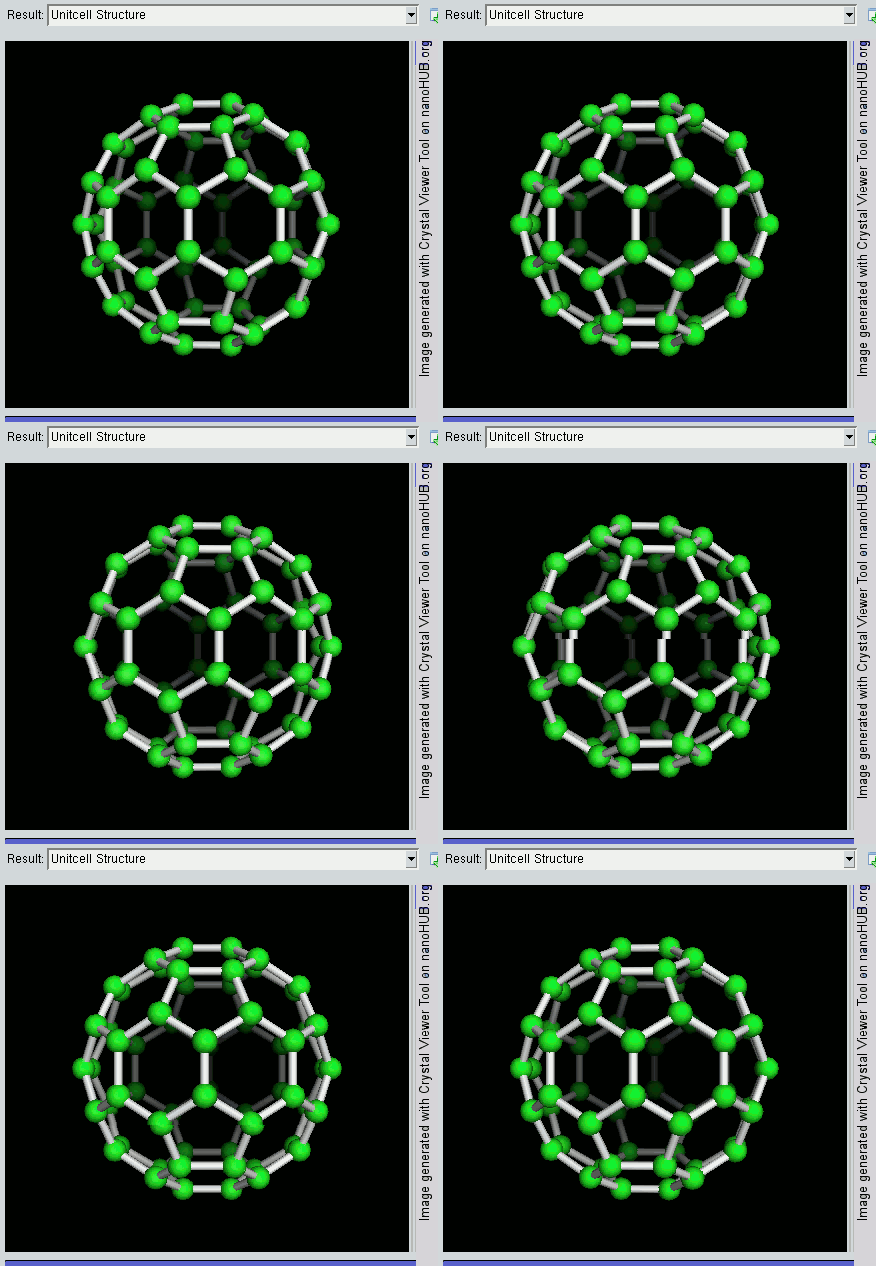
So far, we have become very good friends with two allotropes of carbon -- diamond and graphite. Allotropes are essentially elements in which the atoms have been arranged differently. As a recap, diamond and graphite are both made up of carbon atoms, but diamond adopts a tetrahedral lattice, but graphite has a layered structure. Let's meet another allotrope of carbon -- the buckyball.
The buckyball is made up of 60 carbon atoms, linked together in such a way to form a molecule that looks like a soccer ball. C60 was first discovered by a group of scientists from the Rice University in 1985. They named it buckminsterfullerene, after Richard Buckminster Fuller, an American architect who was one of the first to design buildings that resembled the buckyball (geodesic domes). The scientists, Sir Harry Kroto, Bob Curl and Rick Smalley won the Nobel Prize in Chemistry in 1996 for their discovery.
Discovering the buckyball opened up an exciting field of study, called nanotechnology, which involves the building up of new materials, atom-by-atom. The buckyball is really strong, heat resistant, and is a superconductor -- its electrical resistance drops to zero when its temperature drops beyond a certain critical temperature. Some cool uses of the buckyball include a sponge to mop up free radicals in the brains of stroke victims, a supercomputer the size of a paperback novel, and in photocopier toners to improve the resolution of our photocopies.
Recently, NASA astronomers used the Spitzer Space Telescope and discovered these molecules in space, in a planetary nebula named Tc 1. Planetary nebulas are the remains of stars, like the sun, that shed their outer layers of gas and dust as they age. The buckyball is the largest molecule to be discovered in space so far. This was done by analysing the infrared light given off by the planetary nebula. This is a branch of technology and science known as spectroscopy.
I think the most amazing thing about this discovery is that the telescopes that astronomers have developed to date are able to analyse substances in space down to the molecular level, don't you think?
Thursday, July 15, 2010
Molecular Cooking is Cooking: Molecular Gastronomy is a Scientific Activity
Have you heard of molecular gastronomy? Molecular gastronomy involves the application of scientific techniques into cooking. I tried some of this kind of food a few weeks back and I saw how the chef used liquid nitrogen to make meringue, and "fruit caviar" using compounds such as sodium alginate and calcium chloride.
This is a video of a lecture by a French Chemist, Herve This, given at Imperial College in London. Herve is a physical chemist (physical chemistry is essentially what we are learning now in JC1), whose main area of interest is molecular gastronomy. He is probably one of the leading chemists dealing with the art of culinary. It is a long video, but it is very entertaining to see him performing all sorts of procedures on egg white (or egg yellow, as he calls it) and explaining the Chemistry behind it. The french accent may be a little difficult to get used to, but I love how he constantly proclaims that "eet iz very eeazi".
Enjoy~
Tuesday, July 6, 2010
Cool stuff: The Ice-Calorimeter
From this week onwards, you will find yourself dealing with calorimeters during practicals, tutorials and lectures as we work through the topic of thermochemistry. You have handled the low-tech calorimeter made of styrofoam cups in the lab, and you have heard about a high-tech version called a bomb calorimeter. Have you wondered what the earliest calorimeters looked like and how they worked?
Here is a picture of the ice-calorimeter used by Antoine Lavoisier and Pierre-Simon Laplace to measure the enthalpy changes in 1785:
The chemists will place the reactants (the system) in the basket that you see in the middle of the calorimeter, and then pack ice (the surrounding) around the calorimeter. When the reactants react and produce heat, the ice around the calorimeter will melt. By measuring how much of the ice has melted, the chemists can then determine Q' and subsequently enthalpy change. However, as this deals with the melting of ice (change in state) instead of just an increase in temperature of water in the same state, the equations used to calculate Q' will be different. The Physics students should be able to figure this out.
Lavoisier and Laplace used this calorimeter to show that respiration (taking in oxygen to produce energy) is a form of slow combustion, or as Lavoisier put it "la respiration est donc une combustion". They achieved this by placing a guinea pig in the calorimeter and measuring the heat given out by the animal. The poor guinea pig.
The calorimeter in the photo is currently housed in the Science Museum in London. If you ever have a chance to go there, be sure to check it out. While at it, you can inform the other tourists of the fascinating Chemistry behind it.
Friday, July 2, 2010
Another new element!
In February this year, a new element, Copernicium was added to the periodic table. This element has a proton number of 112, and was at that time, the heaviest element to be officially added. Now, yet another element is on the verge of being included in this table -- element 114. So far, only two teams of scientists in Russia and America have been successful in producing this element, and in total 15 atoms (15 atoms, not 15 moles of atoms) of element 114 have been synthesised.
Element 114 is produced by combining calcium atoms and plutonium atoms. Each calcium atom has 20 protons, while each plutonium atom has 94 protons. When they fuse, they form a new atom with a total of 20 + 94 = 114 protons. Like Copernicium, atoms of element 114 are very radioactive and break down into smaller particles very quickly. On average, these atoms only existed for a few tenths of a second.
Now that the scientists are able to produce element 114, they have to discern the general chemical properties of this new element. To put it simply, they need to know whether they should classify element 114 as a metal or a noble gas. To do this, the scientists need to produce and capture these atoms, and test if they will adhere to a surface made of gold. If they do, element 114 is a metal. If they do not, element 114 is a noble gas as such atoms do not form any attractions with gold (Can you think of the reason why?).
Here is a video about this new element:
Monday, June 28, 2010
Helium: Up, up, and away~
As we go into the topic of ideal gases this week, we are going to encounter the noble gas, helium numerous times. So, why don't we find out more about this gas?
Helium should not be an unfamiliar gas. Everybody knows that is the gas that makes balloons float. Do you know what happens when you try to talk after inhaling helium? Check this video out if you have never tried it before:
Before everybody runs out to buy helium balloons to try sounding like Donald Duck, let me tell you a sobering news: the supply of helium on our planet is running out. We can expect to run out of helium entirely within the next six years. Apart from having a world without balloons that fly away when released, the depletion of helium is going to affect the scientific world in a very significant way. Helium is needed for analytical methods such as mass spectroscopy (to determine the types of elements making up a compound) and NMR spectroscopy (to determine the structure of an organic compound). Commercially, it is also used as a coolant in MRI scanners (used to produce scans of brains in hospitals), and to produce an inert and protective environment for welding.
The helium we have on earth now is formed from the excruciatingly slow decay of radioactive element, uranium. This means that the nucleus of uranium breaks up into smaller nuclei, and in the process, giving out an atom of helium. Decay of the uranium nucleus requires a lot of energy, and takes thousands of years to occur. Even after it is produced, much of it escapes into space of the upper atmosphere, which makes it impossible for us to capture. A scientist said that the supply of helium we are utilising now "has been made over the approximate 4.5 billion of years the Earth has been around". With no fast processes to replenish all the helium mankind has been using, it is no wonder that we will run out of this noble gas.
Some people may ask, can't we artificially create more helium? Well, no. It will require an insanely high amount of energy to imitate how Nature synthesizes helium -- it takes thousands and thousands of years to form helium, even with all the crazily high pressure and temperature in the Earth's mantle. So, we just have to live with the fact that this gas is, for now, non-renewable.
The next time you play with a helium balloon, cherish it. Who knows, maybe your children will never ever get a chance to experience the joys of a balloon that flies away when not held on to tightly.
Sunday, June 27, 2010
Okay, I admit. I have not watched this movie, and neither did I know who this Iron Man is until I heard about the character when watching this wonderful drama series "The Big Bang Theory". But since EVERYBODY is talking about it, I decided to check out what EVERYBODY was saying about it online. And look! I found this very interesting article discussing the Chemistry behind Tony Stark's miraculous synthesis of a new element to cure his palladium poisoning.
Read the full article from New Scientist here.
And while you're at it, why not check out real parallels to the fantastical technology displayed in the first Iron Man movie here.
Subscribe to:
Posts (Atom)